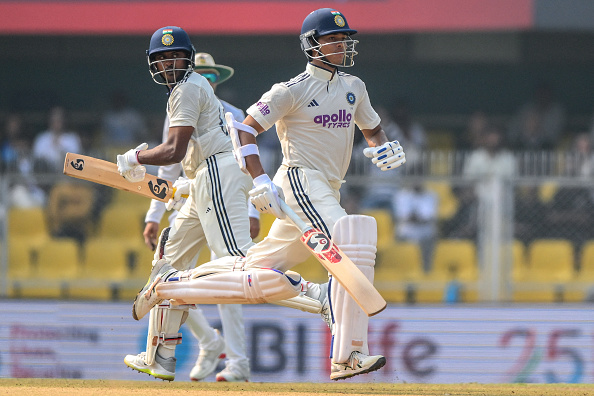
Team India suffered their biggest defeat in terms of runs, losing the second Test to South Africa by a whopping margin of 408 runs in Guwahati on Wednesday (November 26). As a result, the hosts conceded the series 0-2 to Proteas.
This was the second time in a span of just 12 months that India ended up being whitewashed at home. New Zealand won three consecutive Test matches on Indian soil last year.
After the recent debacle, legendary all-rounder Kapil Dev criticizes India's top batters for lacking sufficient domestic cricket experience, which hinders their ability to play spin bowling.
India lost the opening Test in Kolkata by 30 runs, failing to chase a modest target of 124 on a crumbling surface. In the Guwahati Test, the Indian batters succumbed to scoreboard pressure on a flat wicket as the hosts’ two innings folded for 201 and 140.
“Are India’s best batters even playing enough domestic cricket to know how to survive spin anymore?” asked Kapil in an interview with Sportstar.
The 1983 World Cup-winning skipper then highlighted the stark difference between previous generations and the current crop.
“That was because they had individual style, footwork, and the fact that they played good domestic cricket on a variety of pitches. I just want to know how many of today’s top players are playing domestic cricket. That’s the most crucial thing. If you don’t play domestic cricket and don’t face quality bowlers, you are going to struggle,” Kapil added.
The 66-year-old was also critical of the pitches in which Test matches are finishing inside three days.
“The pitches are very, very important. Not the type where the game ends in two and a half days. You lose the toss and lose the game. What is the point of having a pitch where no team crosses 200? It is not good for the state of the five-day game,” he stated.
White-ball obsessed calendar was another big factor highlighted by Kapil Dev behind India’s struggles in home Tests.
“We are more occupied with T20s and ODIs, which means that batters hardly encounter bowler-friendly pitches. On surfaces offering a lot of help to spin and seam, you need patience and a different set of skills to thrive. Once you are ready to play on those pitches, your mindset affects how you tackle them. You do not have batters like Rahul Dravid and VVS Laxman, who knew how to stay at the wicket. Batting in Tests is about staying in the middle,” he remarked.
Kapil was of the opinion that playing spin requires greater skill than handling fast bowling. “You need better skills to tackle spin than to play pace, but it depends on the state of the pitch. If the turn or bounce is vicious, it becomes very difficult. Remember, footwork plays an important role,” he said.
Kapil also spoke about different batting personalities, citing the example of swashbuckling wicketkeeper-batter Rishabh Pant.
“If your temperament is to go and hit like Rishabh Pant, it is different. You cannot as Pant to defend. He is a genuine match-winner. He will go and hit the ball. He is not going to bat 100 balls and make 20. When he hits a six, we all go gaga. Do you tell him not to hit them? He is a batter who can demolish the opposition.”
Kapil is not in favour of changing Pant-like batters, but emphasized on the system that once produced gutsy batters like Ravi Shastri, Mohinder Amarnath and Sunil Gavaskar.
“I was surprised that India lost to New Zealand and South Africa at home, but we should have prepared better. Test cricket is different. You ask a person like me to defend, it will not work. But you ask someone like Ravi Shastri to bat the whole day, he will do it. Jimmy Amarnath and Sunil Gavaskar could stay in the middle for the entire day. They had the temperament because they played a lot of domestic cricket,” he concluded.