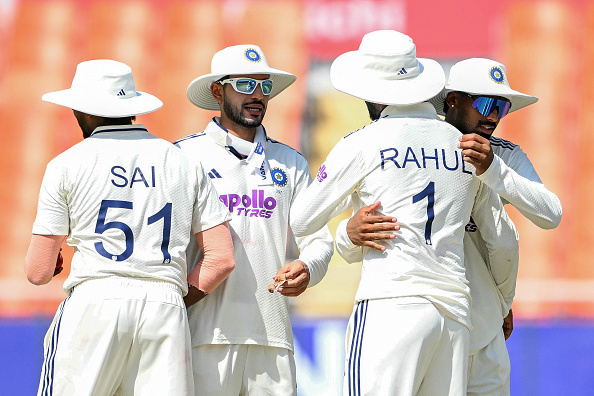
 India registered their biggest-ever Test victory by defeating Afghanistan by an innings and 300 runs on Day 3 of the one-off Test match in Mullanpur.
After winning the toss, the hosts chose to bat first and declared their first innings at a massive 564/8, with Shubman Gill (126) and KL Rahul (100) slamming superb centuries.
In reply, Afghanistan’s first innings folded for just 152 runs. Left-arm spinner Manav Suthar stole the show on Test debut for India, returning with spectacular figures of 6 for 33 in 22 overs.
Forced to follow on, the visitors were bowled out for a mere 112 runs in 35.5 overs. Washington Sundar tore through the line-up with 4/36, while Kuldeep Yadav chipped in with 3/30.
Despite the dominating win, legendary Sunil Gavaskar identified batting discipline and technique as India's primary unresolved concern, rather than any bowling deficiencies or transitional growing pains often cited by the team management.
Speaking on JioHotstar, Gavaskar argued that it is time to stop using "transition" as an excuse. He noted that every international team goes through retirements, and India's focus should remain firmly on performance.
"It's time to move away from constantly describing this team as being in transition and instead focus on the standards expected in Test cricket. Every team goes through retirements, changes in personnel, and periods of evolution, but ultimately the emphasis has to remain on performance," Gavaskar said.
Pointing to India's recent home Test series defeats against New Zealand and South Africa, Gavaskar highlighted that the batters need to show greater discipline and build longer innings.
"Looking back at some of India's recent Test results, the bigger concern has been the batting rather than the bowling. The bowling attack has generally done its job, but the batters need to show greater discipline and stronger technique, especially in challenging situations," he stated.
Gavaskar specifically warned against allowing T20 habits to seep into Test cricket. "At times, there is a tendency to slip into a T20 mindset where patience becomes difficult after a few dot balls, and that can lead to poor decisions. Test cricket demands a different approach. India's focus going forward should be on tightening their batting processes, building longer innings, and concentrating on the present rather than viewing every result through the lens of transition," he added.
Gavaskar's remarks stand in contrast to Gambhir's evaluation following India's 2-0 series sweep against South Africa last year.
"We played nine Test matches, did brilliantly in England and then beat the West Indies," Gambhir had said. "So when people talk about transition, that's where it really began. If, after nine Test matches, you still feel it's a long rope, I don't necessarily agree."