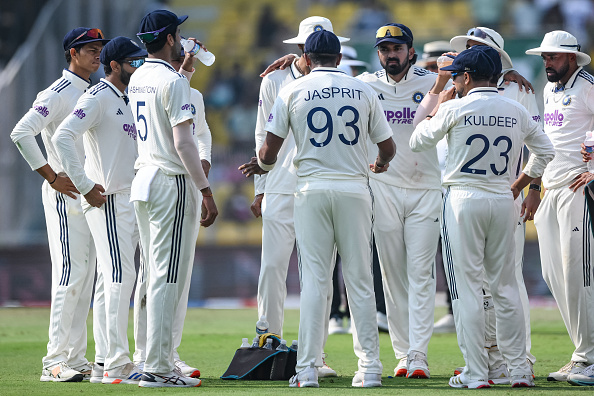
India's upcoming all-format tour of New Zealand begins on October 22 and runs through December 1, featuring five T20Is, five ODIs, and two Test matches.
The two-match Test series is a pivotal battleground for the 2027 World Test Championship (WTC) Final qualification. While New Zealand hold upper hand in recent encounters, India's head coach Gautam Gambhir has voiced strong confidence in his pace unit's ability to extract 20 wickets under seaming conditions.
Ahead of the tour, legendary spinner Ravichandran Ashwin advised the Indian think tank to field four frontline fast bowlers in the New Zealand Test series rather than relying on seam-bowling all-rounders at No. 8.
He emphasized that genuine quicks capable of taking five-wicket hauls are necessary for Test success, dismissing bits-and-pieces cricketers as unsuited for the format.
“This is always a very debatable point. Very often you’re going to have your three frontline fast bowlers, and then one spinning option between (Ravindra) Jadeja and Washington (Sundar). Eventually, that’s how it needs to be,” said Ashwin in an interaction arranged by Sony Sports.
“With Jadeja there, he’s got enough experience. And if you’re going to play Jadeja and Washington together, which makes two spinning all-rounders in the top seven, that’ll be an interesting take. Your 8, 9, 10 and 11 then have to be four genuine quick bowlers who can get you wickets.
“If you’re looking for a pace-bowling all-rounder, they have to bat in the top five. You cannot have somebody walking in at No. 8 who can maybe make runs and also maybe give you a few overs. If you’re going in with four quicks, it’s got to be four genuine quicks who can all pick a five-wicket haul on a given day.
“That should be the ideal combination, and you shouldn’t look to stretch the seam bowling with bits-and-pieces cricketers. They are sometimes okay in the white-ball formats, where they can give you combination advantages, but not in Test cricket,” he explained.
Commenting on the role of spinners for the T20I series, Ashwin highlighted that New Zealand’s drop-in pitches and small grounds (such as Auckland, Hamilton, and Wellington) require the slow bowlers to adapt to a defensive, disciplined role rather than trying to act as primary attacking weapons.
“Some of the pitches in New Zealand are drop-ins and some of them are natural turfs. Some of them are small grounds, for example Auckland and Hamilton, and even the T20 ground in Wellington is pretty small. So being aware of the side boundaries and changing your lines and lengths are very important. You might not necessarily be a potent attacking weapon.
“Depending on the game scenario, we should be able to bowl a little defensively, which I think on occasions the Indian spinners have failed to do. Hopefully they can adapt and also understand that defensive bowling can be critical in T20s,” he remarked.
Ashwin stated that predicting top performers in a Test series is always challenging, but he firmly believes the upcoming series "will revolve" around KL Rahul and Shubman Gill. He noted that if these two carry their responsibility well, India will be in a prime position to win the series.
“With respect to batters, it’s very tough to really predict who is going to have a great time. But with what’s gone by, I would really pick Rahul and Shubman, around whom this series will revolve. I think the Indian batting line-up will have to lean into their experience a lot.
“I’m not counting others out either, but with the experience, form and pedigree that KL and Shubman Gill are carrying at the moment, I’ll put my money on them to have a good series. If they do, India have a great chance.”
Ashwin downplayed workload concerns even though India’s home white-ball series against the West Indies concluded on Saturday (October 17).
“I don’t see it as an issue, because a lot of the T20 players don’t play ODI cricket and a lot of the ODI players don’t play Test cricket. Those times are probably gone by. Shubman Gill is probably one of those who will be there for the entirety of the series.”