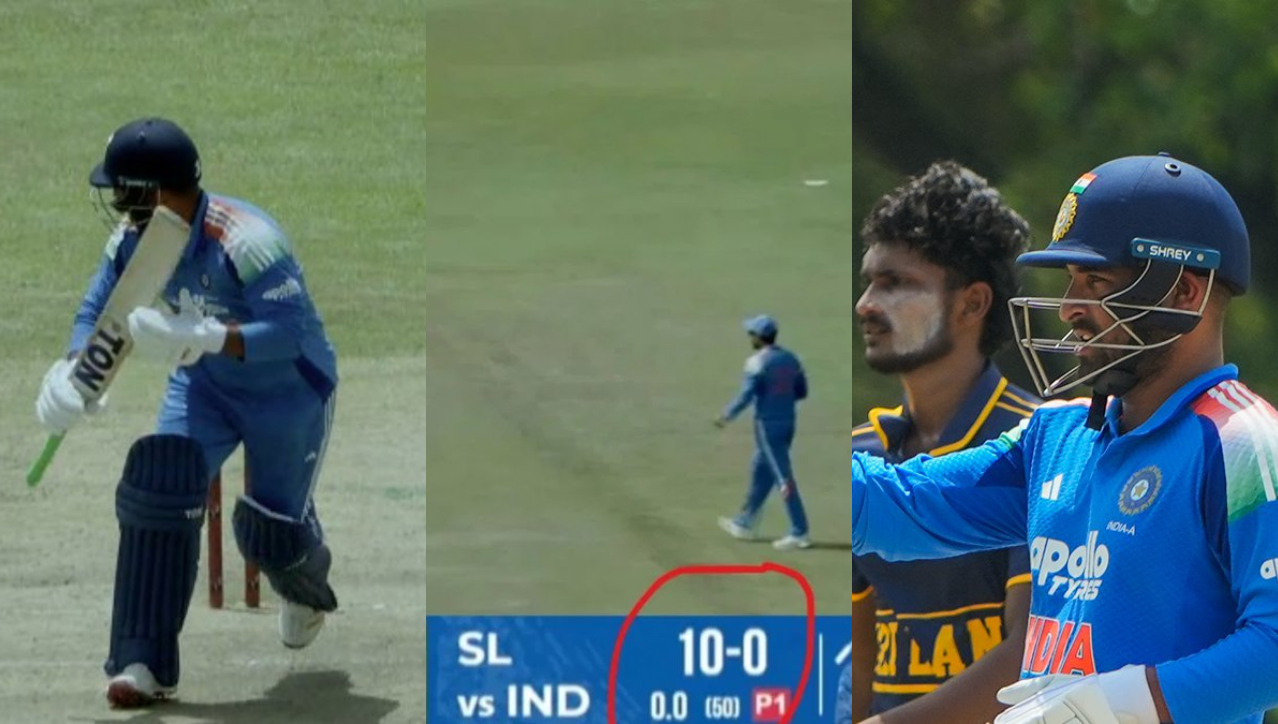
 The India A team, who are currently clashing with Sri Lanka A in the ongoing one-day triseries in Dambulla on June 15, 2026, were docked 10 runs in penalties courtesy of all-rounder Vipraj Nigam.
Sri Lanka A captain Sahan Arachchige won the toss and chose to bowl first. And his decision was proved correct by his bowlers as India was reduced to 143/7, with Ruturaj Gaikwad (37), Tilak Varma (23), and Vaibhav Sooryavanshi (21) being the main scorers.
Then Suryansh Shedge and Vipraj Nigam got together to do the repair job and added 104 runs for the 7th wicket. Shedge made 72 in 66 balls with 3 fours and 2 sixes, while Nigam made 51 in 49 balls with 6 fours. India was bowled out for 265 runs, with Mohamed Shiraz and Vijaykanth Viyaskanth taking three wickets each.
However, Sri Lanka A began their chase with 10 runs on the board without a ball being bowled. And the reason was India’s Vipraj Nigam, who was penalized twice for running on the pitch by the on-field umpires.
The first instance happened in the 35th over, when Nigam ran in the middle of the pitch and was handed a second warning, and a 5-run penalty was imposed. Nigam did the same thing again in the 37th over, when he attempted to guide Kugathas Mathulan's delivery towards the short third-man region and go for a quick single. This ended up with India being levied a 10-run penalty in all.
Anukul Roy received a first warning for rushing in the middle of the field. The caution was in place for the remainder of India A's batting innings even after he was removed in the 33rd over. Therefore, any additional infraction when Vipraj reached the middle would have automatically resulted in a five-run penalty.
According to MCC Law 41.14, "It is unfair to cause deliberate or avoidable damage to the pitch. "If the striker enters the protected area while playing or playing with the ball, he/she must move from it immediately thereafter. A batter will be deemed to be causing avoidable damage if either umpire considers that his/her presence on the pitch is without reasonable cause."
"If either batter causes deliberate or avoidable damage to the pitch, other than as in 41.15, at the first instance the umpire seeing the contravention shall, when the ball is dead, inform the other umpire of the occurrence. The bowler's end umpire shall then warn both batters that the practice is unfair and indicate that this is a first and final warning. This warning shall apply throughout the innings. The umpire shall so inform each incoming batter. Inform the captain of the fielding side and, as soon as practicable, the captain of the batting side of what has occurred (41.14.3)," the rule further states.
"If there is any further instance of deliberate or avoidable damage to the pitch by any batter in that inning, the umpire seeing the contravention shall, when the ball is dead, inform the other umpire of the occurrence. The bowler's-end umpire shall disallow all runs to the batting side, return any not-out batter to his/her original end, signal no ball or wide to the scorers if applicable, award 5 penalty runs to the fielding side, and award any other 5-run penalty that is applicable except for penalty runs under Law 28.3 (protective helmets belonging to the fielding side), the rule says.