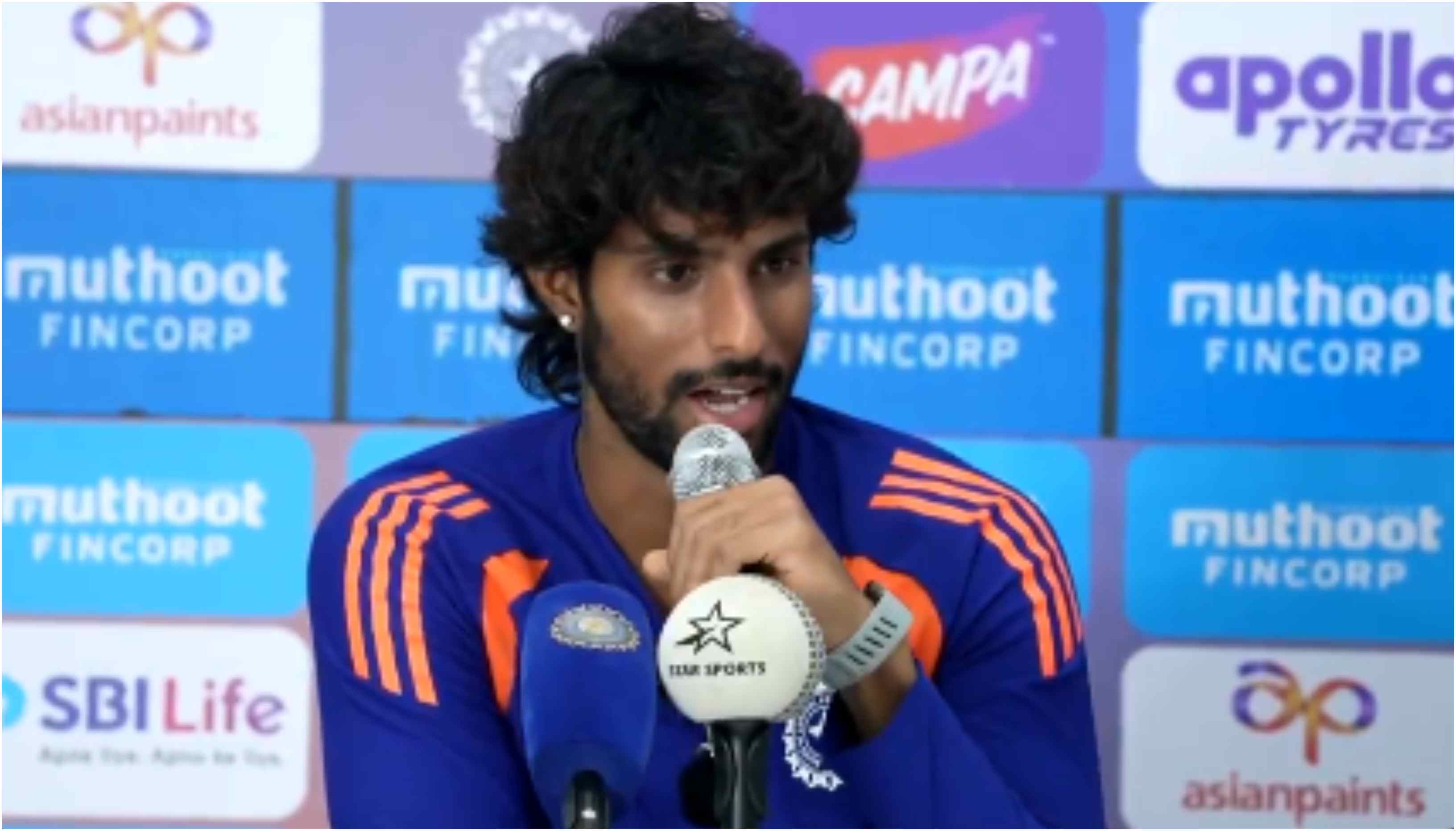
On the eve of the fourth T20I against the West Indies in Hyderabad, India vice-captain Tilak Varma shared insight on the tactical differences between batting at No. 3 and the middle-order roles.
The southpaw, who has scored two T20I centuries at one-drop, emphasized that batters enjoy freedom in that position because only two fielders are outside the 30-yard circle during the Powerplay, allowing players to swing freely without early pressure.
For the No. 4 and No. 5 slots, Tilak said this role requires handling early-wicket collapses or coming in with only two or three overs left to hit from the very first ball, demanding strong mental toughness built on fundamental skills practiced since childhood.
"At No. 3, you have the freedom. There are only two fielders outside and you will get to bat in the Powerplay. And you don't have any expectations, so you can swing freely. Every batsman enjoys playing that role, especially in T20.
"After that, when the anchor role starts at No. 4 and No. 5, sometimes the wickets fall early. Sometimes you know you will have to hit from the first ball, with only two or three overs left. For that role, you have been practising the basics since childhood. But more than that, I think you have to be mentally very strong," Tilak told reporters on Tuesday (October 13).
Tilak Varma has embraced the lower-order role by viewing pressure as a unique opportunity to step up and win games for his team. Rather than seeing the shift as a demotion, he takes genuine pride and satisfaction in adapting to whatever the team requires.
"I am the man who always wants that pressure," he stated. "When the team needs it, I want to step up for that role. Right now, I think my role is to handle the middle phase, like overs 5, 6, 7. If quick wickets go [fall], I can take my time slightly and take the game deep. I can do that role.
"And I have one more role: if the openers or the top three bat till the 14th or 15th over, I know how to change gears and get going from the first ball. I have been practising for that, especially the mindset. It's really important to play both games. When the team is under pressure, you should take it deep. And when the team needs it from the first ball, you should go. For that, I am really ready.
"By God's grace, it's going well. I have worked really hard. Right now, I'm enjoying this moment. When someone like Ishan, Shreyas and the openers are batting, it's really a treat to watch. So I don't want to disturb any role. Whatever the team needs, I want to do it."
To balance these opposing roles effectively, the left-hander focuses on two guiding principles -- unshakeable self-confidence and tactical adaptation.
"You have to have confidence in yourself. If you don't have confidence in yourself, the team will never have confidence in you. Since childhood, my coach has taught me that whatever the role, whatever situation you are in, if you win the game for the team, it's a different kind of fun.
"So whatever position I go in at, I just see how I can win it for the team from there. After that, I look at the conditions, which bowler I can hit, and which shots I can play on that wicket. I adapt all that and use it on the ground," he remarked.
The penultimate T20I will be Tilak’s first international game in front of his home crowd since cementing his place in the national setup and achieving leadership status.
"It is a really proud moment that I am leading the Indian side as vice-captain and playing in front of the Hyderabad crowd," he said. "It will be a really special moment for me."
Tilak Varma also addressed his bizarre run out from the third T20I in Indore, where he stopped midway through a run believing the ball had already crossed the boundary for a four, and was caught short of his crease.
"A lot has been said about the run out,” Tilak remarked. “I saw a flash [from the digital boundary hoardings] and personally felt that the fielder touched the hoarding with his hand while flicking the ball in. Axar [Patel] also felt the same, so we both stopped at the same time. It wasn't that he or I stopped first. The ball was thrown to Axar's end, so he could see it, but at the non-striker's end, I was facing the other way. Our teammates were shouting from outside, 'go, go, go.' If Axar had known any better, he would have shouted and I would have run.
"In life going forward, I will never stop, even if the umpire signals a boundary. I will just keep running [laughs]."
(With Cricbuzz Inputs)